
By Ben Coley
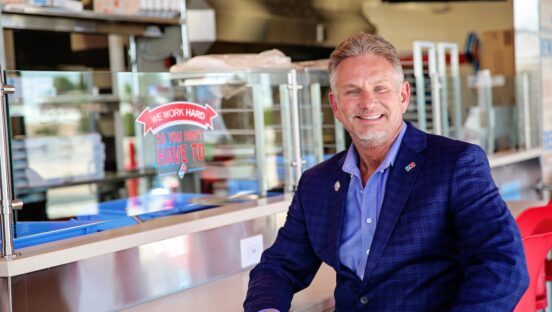
Although Papa Johns reported another quarter of negative same-store sales in Q1 2026, CEO Todd Penegor and his team aren’t panicking.
The brand knows it’s navigating a complicated macroeconomic environment and is faced with balancing near-term pressure on transactions with a longer-term transformation plan based on innovation, value and operational discipline.
And that’s regardless of what its pizza peers may be doing.
“Although certain competitors have outlined their strategy to compress restaurant margins in the sector, we are taking a disciplined approach, executing a balanced transformation that extends well beyond price, meeting customers where they are while improving four-wall margins, elevating our fleet and supporting our franchisees to build this business for the long term,” Penegor said recently.
That balance is being tested in North America, where same-store sales declined 6.4% in the first quarter, driven primarily by lower transaction volumes. Fewer new customers are entering the system, even as core users remain engaged.
The chain’s North America comps have been negative for eight of the past nine quarters.
Papa Johns reported flat year-over-year pizza volumes excluding weather impacts, with customers ordering more pizzas per transaction. Additionally, pies per order increased 5% versus last year. The traffic loss is coming from fewer guests ordering one or no pizzas.
To address this, Papa Johns is leaning heavily into value and trying to avoid the margin compression seen elsewhere in the category. The company continues to promote offers like BOGO, a $9.99 three-topping pizza, and its Papa Pairings platform, using its CRM system to drive more targeted engagement and frequency among existing users.
Leadership is also clear that value alone won’t solve the growth challenge. Innovation is playing an increasingly central role in the strategy, particularly when it comes to attracting new customers and expanding occasions.
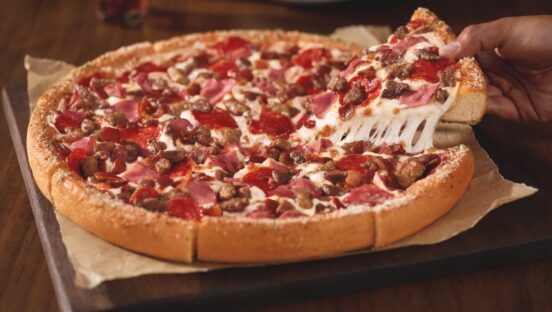
The company rebuilt its innovation pipeline to deliver more consistent product launches, and early 2026 has already seen the introduction of two major platforms: Pan Pizza and oven-toasted sandwiches. Both are designed to broaden the brand’s reach beyond its traditional core.
Pan Pizza, launched at the end of January, addresses a longstanding gap in the menu. It has been met with strong repurchase rates, and there are plans to boost awareness around the menu item throughout the year.
The sandwich platform, introduced in March, represents an even bigger shift. By entering a new category, Papa Johns is aiming to capture additional dayparts and occasions. Early results suggest the move is resonating. The sandwiches have already exceeded sales of Papadias, which were replaced, and simplified operations. The product has driven participation across lunch and dinner and contributed to sales expansion.
Papa Johns is also working to improve attachment rates and check size through side items. The recent launch of Cheesy Garlic Bread is part of that effort.
Technology is another major pillar of the U.S. strategy. The company continues to invest in digital tools to reduce friction and improve the customer experience. Papa Johns made to-the-door delivery tracking a brand standard across the U.S. system. Additionally, its partnership with Google Cloud is beginning to shape the ordering experience, with voice and text ordering capabilities rolling out across the system. So far, leadership has seen faster ordering and higher conversion rates.
Papa Johns hopes to combine this innovation with a renewed marketing approach at the local level. The reintroduction of advertising co-ops is meant to improve relevance and targeting in individual markets. The company is also using partnerships to reach new audiences. A high-profile collaboration tied to the upcoming release of “Toy Story 5” is expected to drive engagement through themed products, promotions, and digital experiences.
Despite these initiatives, the competitive environment remains intense. Pricing pressure is coming not only from pizza rivals but from across the broader quick-service industry. That pressure is visible in third-party delivery channels, where competition has intensified over the past year. Third-party continues to outperform first-party in terms of growth, but it is also becoming more dynamic and competitive.
Amid these headwinds, Papa Johns is focused on improving profitability at the restaurant level. Company-owned stores delivered a 4-wall margin of 11.9 percent in the quarter, up 1.4 percent year-over-year.
The company is also taking steps to optimize its restaurant base, closing underperforming units and cutting its company-owned footprint. Papa Johns announced earlier this year that 300 North America restaurants—200 in 2026 and 100 in 2027—will shutter. Closures are targeted at older, lower-volume locations that lack a path to improvement. After removing units, Papa Johns has seen notable sales transfer to nearby stores.
The company expects North America comparable sales to decline between 2 and 4 percent for the year, with improvement in the back half as new products, marketing initiatives, and partnerships gain traction.
“While transformation work is neither linear nor instant, we are confident that the progress we are making in Papa John’s transformation, combined with the strength of our brand and quality of our pizza will fuel profitable growth and value creation over the long term for all our stakeholders,” Penegor said.
Papa Johns finished Q1 with 3,487 North America locations after shuttering 44 units in the quarter.
Internationally, same-store sales increased 3.6 percent. The brand ended Q1 with 2,533 restaurants outside of the U.S.
This story originally appeared on PMQ Pizza’s sister site, QSR.com, and can be viewed here.