
By Matt Plapp
About 10 years ago, LaRosa’s Pizza in Cincinnati sent me a free cookie for joining their loyalty program. I used it on my next order. And I have spent $10 on cookies in our LaRosa’s orders ever since.
That shows you how one free cookie can create a decade of higher check averages. That’s what retention looks like when you do it on purpose.
I’m Matt Plapp, CEO of America’s Best Restaurants. We help independent restaurant owners win through our three pillars: Attract Attention, Build a Database and Retain Your Customers. The goal is to win more new customers, win back lost customers, win more frequent customers, win higher check averages, win your community’s attention and win against the chains.
This article will explore two of those wins: frequency and check average.
The Two Ways to Grow That Everybody Ignores
There are only four ways to grow sales in any business: Get new customers. Win back lost ones. Get current customers to visit more often. Get them to spend more when they come.
Most owners pour everything into the first one, panic about the second one once a year and ignore the last two. That’s backward. The people who already love you are the cheapest sales you will ever make.
Before you pick a strategy, know three numbers: where your sales are now, where they should be and where they could be.
I talked to an owner recently doing $1.2 million in sales. He should be doing $1.7 million, because those are the same numbers he was doing five or six years ago. That’s a $500,000 gap just to get back to “should be.” I call it the sales gap, and the next question is always the same.
Most restaurants are 12 to 18 months from making an extra $200,000 with the right plan. But the question always comes down to:
- What’s the plan to close that gap?
- What are you willing to invest to get it, in terms of time and money?
Strategy 1: Smart Offers, Not Dumb Discounts
A pizzeria in Columbus, Ohio, runs the Dryver Loyalty program, which has a feature called Smart Offers. The system sorts the loyalty database into 10 spend tiers, from $0 to $10 up to the top of their checks. Each tier gets its own offer. If you normally spend $10 to $20, you get double points this week when you spend $10 more than your normal. That’s a seven-day window with no discount and no coupon—just points. But they get it only when they spend over that new threshold.
Now, that customer has to look at the menu and find something they wouldn’t normally order. That’s the cookie moment.
Compare that to a very popular loyalty program I saw the other day that blasts everyone with the same deal: Spend $20, get double points. If you’ve got 10,000 active members and 90% of them already spend $20, what did you change? Nothing. You paid your best customers to do what they were already going to do. Stop doing that.
The Columbus pizzeria ran one Smart Offer each month, on June 14, July 12 and August 9. They sent three emails and made $7,352 in incremental sales. That’s $1,900 in pure profit. That’s three emails to their top customers that brought in 150-plus visits and paid their rent for one month. They needed to send only three emails!
Actually, they needed to send three very strategic emails with a system built around building sales and profits from your top customers.
Take June as an example. The offer generated 50 tickets and $2,700 in sales. Of that amount, $1,133 was a spend bump, meaning dollars above what those exact customers normally spend. How do we know the offer drove it? Why else would somebody whose last 10 visits averaged $25 suddenly spend $40?
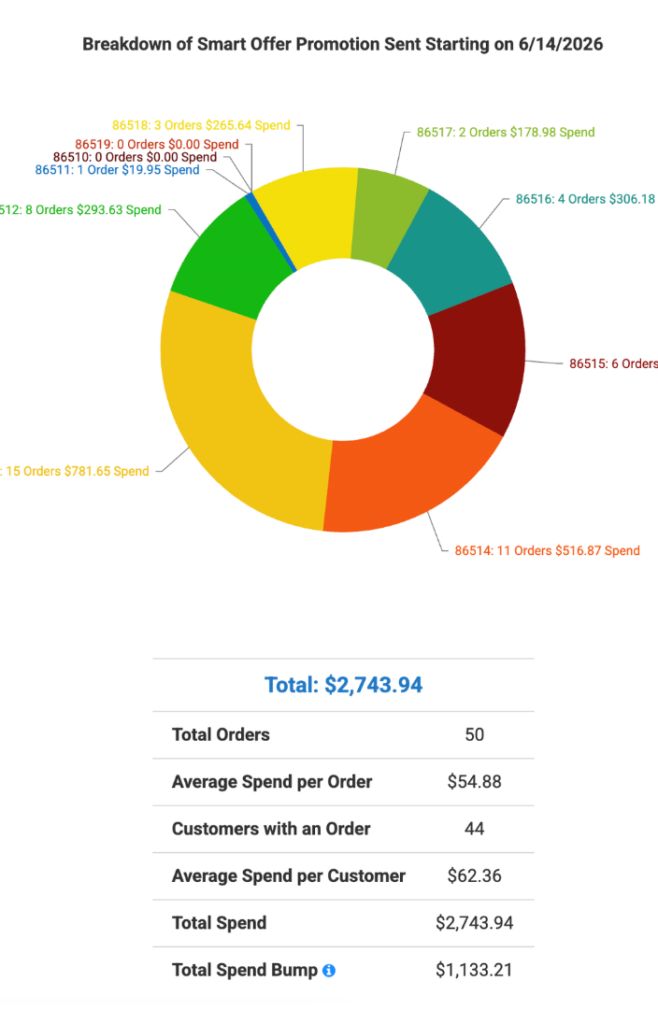
The only cost is food. Pull 30% off that bump, and one email dropped about $700 in profit into the register. One email.
Now stack your efforts: a smart offer, plus an acquisition program, plus a lost customer strategy, all running every month. Next thing you know, you’re stacking $3,000 to $5,000 in profit every month. For an independent operator, that’s a raise. And every customer who tried something new and loved it keeps ordering it. Just remember my LaRosa’s cookie habit!
Strategy 2: You Are the Difference
The Chipotle down the street has no owner. It’s corporate. The franchisee who owns the McDonald’s, the Texas Roadhouse, or the Taco Bell is there to collect money, not build a relationship with your town.
You are the differentiator for your business. Get on camera and tell stories about you, your team, your food and your community.
Mike at Fine Folk Pizza in Fort Myers does a great job with this. Go to his Facebook page, and you’ll see Haley, his general manager, walking viewers through their pizzas. You’ll see Mike out in the community and talking about his journey as an owner. Domino’s can’t do that. Papa John’s can’t do that. California Pizza Kitchen can’t do that.
That kind of exposure keeps you in customers’ heads between visits. It also sets up strategy three.
Strategy 3: Retarget the People Who Raised Their Hand
Every time someone watches your video, Facebook remembers. Inside Ads Manager, you can build a custom audience of people who watched 3 seconds, 10 seconds, 25%, 50%, 75% or all of it.
About a month ago, my team went into Mike’s Ads Manager, picked a handful of those videos, and pulled the people who watched a meaningful chunk. In that short window, he’d built an audience of 1,000 to 1,300 people.
Think about that. You might have 20,000 people see your page in a month. But the person who stopped and watched 30 seconds of a two-minute video about your pizza? There’s no other reason than they like your brand. Those are the people you put an ad in front of, with calls to action like: Order tonight. Come in for kids night. Try the new special.
I do this for ABR, too. I have a custom audience of 84,000 to 98,000 restaurant owners who watched at least half of our Roadshow videos. When I want to drive sales, I’m not advertising to everybody. I’m talking to them.
Loyalty gets them to spend more. Video separates you from the chains. Ads bring the people who already raised their hand back through the door. That’s how a one-location pizzeria lives rent-free in someone’s head, rather than a 13-location chain.
Your Homework This Week
Make one Smart Offer to your loyalty members. Not on Dryver? Call your loyalty provider and ask if you can segment by average spend and trigger double points when a customer beats their own normal. Odds are, they have something close.
Remember, attract them with points, not discounts. In exchange, you get more revenue today and a new habit tomorrow. Somewhere in Cincinnati, LaRosa’s is still counting my cookie money.
For more guidance, take America’s Best Restaurants free WIN Audit to see exactly where the gaps are in your restaurant’s marketing. And if you want to go deeper, join our free ABR Skool community, where we help owners and their teams dominate all nine strategies under the ABR pillars.