
By Tracy Morin
On July 7, Women in Pizza and PMQ will bring together some of the brightest minds in pizza for our first female-paneled webinar, “Pizza Women On the Rise: Claiming Your Space in the Pizza Community.” Co-moderated by Alexandra “Azie” Mortati of Women in Pizza and PMQ associate editor Tracy Morin, the webinar will gather three female pizzeria industry standouts—Giorgia Caporuscio, master pizzaiola and owner of Don Antonio; Erica Bell, lead pizzaiola and general manager at Double Zero Pie & Pub; and Audrey Kelly, owner and pizzaiola of Audrey Jane’s Pizza Garage—as they share the challenges they’ve faced, the victories they’ve achieved and the progress still to be made.
In this special series of profiles, we will learn more about each of the women featured in the webinar.
“I did not start this thinking that I would be a face or have to be super public,” says Alexandra Mortati—with a laugh that recognizes how wrong she was. “That kind of blew up in my face.”
Mortati only wanted to highlight women in pizza when she started Women in Pizza, a movement that she helped spearhead while working in her family’s business, Orlando Foods. There, she serves as VP of marketing—leading brand strategy in the U.S., overseeing a dynamic, growing team, and combining her passion for storytelling with the food industry.
But Mortati, known as Azie, has also become a driving force behind the Women in Pizza nonprofit, which helps build community, amplify voices and create meaningful connections across the industry. In this role, she is similarly focused on the intersection of people, food and narrative, and she brings a thoughtful, creative approach to marketing Women in Pizza while staying rooted in the relationships that define the pizza world.
But she’s still not one who revels in recognition. “It definitely puts me out of my comfort zone,” Mortati says. “I think it’s probably healthy and a good thing, but [Women in Pizza] is to highlight other women in the industry. So I’d rather keep giving them opportunities!”
Fortunately, Mortati was willing to take a moment in the spotlight via a chat with PMQ about the history of Women in Pizza, how it’s grown, where it’s headed and how everyone—male or female—should get involved.
PMQ: How did you start out in the food business?
Alexandra Mortati: I work, in my 9-to-5, for my family’s food importing business. When people ask, “How long have you worked there?” I say my whole life, but it’s officially been seven years. I grew up working there, in middle school and high school, and when I wasn’t doing an internship in college—I was always working for the company in some capacity.
When I graduated college, I worked two different jobs in New York City. Living in New York is very expensive, and I was in an entry-level job, making no money. I remember saying to Fred, my dad and one of our owners, “You have no marketing. You’re in food. Why don’t I help you? And I can start doing social media for you on the side.”
This was a way to earn some extra money, so I could either pay rent or buy food! He said, “That’s a great idea.” So, for a few months, I was kind of moonlighting and doing some marketing for them outside of my regular job.
PMQ: How did you begin your journey with Women in Pizza?
Mortati: They had just come back from Pizza Expo in 2019, and I saw that they were doing what they called a Women in Pizza Power Hour. I think it was the second year they had done it. They kicked all of the men out of our booth and invited all of our female friends and customers in to make pizza, network and show their skills.
When they came back, I said, “Why is that something you have to do for one hour of the year, not all of the time?” And they said, “Well, we don’t have the resources right now to really create anything, but if you’re passionate about it, we’ll support you 100%.”
So, around the time that I was starting to transition over to the company full-time, one of the first initiatives I started was Women in Pizza. We started to create the logo and figure out what I wanted it to be. I presented to Fred and Carlo, my uncle, who is our other owner, a 20- or 30-page packet of information about all of the things I wanted to do when I came on full-time, and Women in Pizza was a substantial section of it.
It started as a very grassroots social movement. Our goal, originally, was to identify eight ambassadors around the country so we could eventually host networking events and pizza events at their locations and help create communities in their areas. But then COVID happened six months later. We realized we needed to pivot—there wasn’t going to be anything happening in person.
It really started becoming a storytelling platform, and it kind of exploded from there. We told more stories, more women reached out and they started connecting with one another. People would reach out to me asking for introductions, mentorship, advice or connections with someone they respected in a particular city.
A few years ago, we formalized it as an official nonprofit 501(c)(3) entity. My goal is, by the end of this year, to start offering grants and scholarships and to launch a formalized mentorship program. It’s been very informal so far—just someone reaching out with questions or looking for connection or advice.
PMQ: How has Women in Pizza grown since you started?
Mortati: We have more than 500 members now! Only about 27 are currently listed on the website, but we’re redoing the website and creating a full member directory that’s live and active. So it’s definitely growing a lot. And there are still a lot of women that I know and consider Women in Pizza members who aren’t even registered.
My goal is one day to not to have to say “Women in Pizza,” because there will be more equal representation. I’m hoping Women in Pizza also encourages more women to join the industry. I think there are so many women out there [who want to join the industry], and if you don’t see yourself represented, it’s hard to imagine yourself doing something, or to think that you should speak up, because you don’t see other people like you being elevated or recognized.
PMQ: What are your future goals for Women in Pizza?
Mortati: For the nonprofit itself, it’s for us to really start making opportunities more accessible to women that they might not otherwise have—through offering grants and scholarships or even a more formalized mentorship program, so they really feel like they have resources and guidance that they might otherwise be struggling to find. That way, they can reinvest in themselves and in their businesses to help them grow, which only helps the industry as a whole.
From a larger perspective, I hope women continue to be recognized, and it encourages more women to go out and compete, to elevate themselves, to share their stories, and to empower other women around them.
I hope we see more women in leadership roles, whether that’s in a restaurant, on the distribution side, on the manufacturing side or on the franchise side. I hope, no matter what, we just see women consistently being elevated and recognized for everything that they’re doing, and that they’re given a path to succeed. I hope that glass ceiling just keeps getting shattered so they can keep achieving more and more.
PMQ: If someone wants to get involved with Women in Pizza, where should they start?
Mortati: Follow us on social media @womeninpizza and also DM us directly. Go on our website; hopefully, it will be new by the end of the summer. People can register to join there, and then they’ll be in the loop for all of our communications. We have emails that go out to alert people to anything we have going on. They’ll be notified about the new website and any new programs we’re doing as well.
PMQ: Is there anything else readers should know about Women in Pizza?
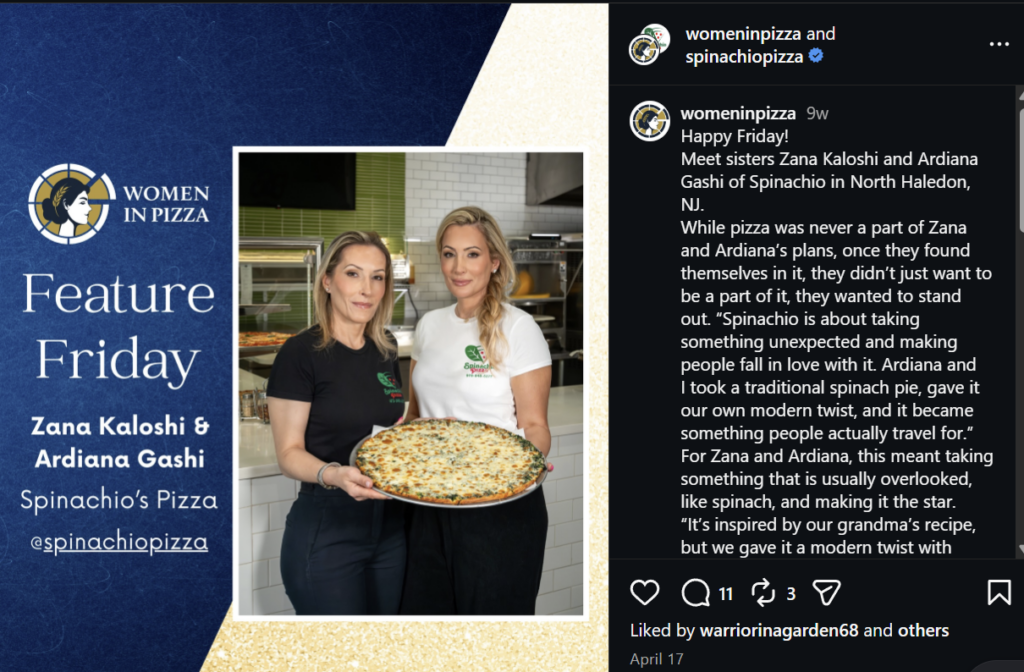
Mortati: We do a Feature Friday series. Most Fridays, we do a bunch of posts on social that tell one woman’s story—her journey in pizza, any advice she has, achievements, obstacles, things like that.
If other women are reading this and want to get involved, they can absolutely reach out to us. We want to keep highlighting women and helping spread the word.