


By Matt Plapp
I’m Matt Plapp, the CEO of America’s Best Restaurants, and we help independent restaurant owners win. We do it through their marketing and by leveraging our three pillars: Attract Attention, Build a Database, and Retain Your Customers. The whole point is to help you win more new customers, win back lost customers, win more frequent visits, win higher check averages, win your community’s attention and win against the chains.
So let me start with a hard truth: The No. 1 lever you can pull for your marketing inside your four walls is your loyalty program. Not a billboard or radio spot—the thing sitting right there in your point of sale that most owners treat like an afterthought.
Here’s the problem: You can’t out-footprint the chains. I’m sitting in Northern Kentucky right now, and every single route out of my office runs me past a different Chipotle. Drive to downtown Cincinnati, and I might pass 10 of them. You are probably never going to have 10 locations in your backyard, and you can’t match their marketing budget. That’s not the game.
But you can win a different footprint. The average consumer opens their phone 144 times a day for social, email, texting and browsing the internet. You, me, your employees, your customers—we all live on that device. So while you can’t win the physical footprint, you can absolutely win the footprint inside your customer’s phone. That’s where loyalty lives, and that’s where it plays inside the Retain pillar. You attract attention, you build a database, and loyalty is how you retain those people and pull them back through your doors over and over.
Loyalty won’t fix everything. It’s not going to win you a ton of brand-new customers. But it crushes the other three ways to grow sales: bringing back lost customers, getting people to spend more when they visit, and getting people to visit more often. To make it a real weapon, you need five things rocking. Here’s what they are.
Key #1: You Have To Constantly Gain New Members
Every loyalty program launches with a honeymoon. You get two or three months of momentum, and then it falls off a cliff. Why? Because you already burned through your early adopters. Every restaurant has die-hards who’ll take any offer you put out, even a bad one. Once they’re in, the well runs dry—unless you keep filling it.
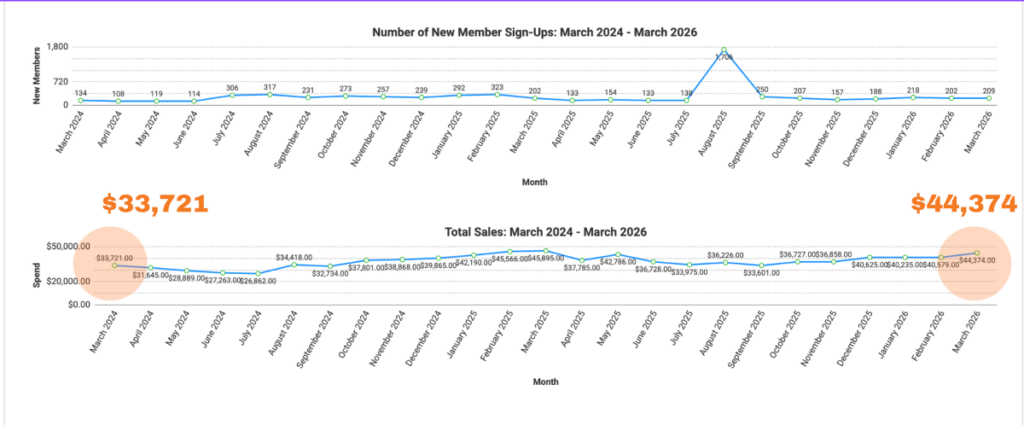
Papa Kelsey’s Pizza & Subs out in Arizona has run the same loyalty program since 2010. From March of 2024 forward, they went from $33,000 in monthly loyalty sales to more than $40,000. They added five to 10 grand a month. They didn’t do it by raising prices or by squeezing existing members, but by adding members. More people, more chances to sell.
Most restaurants don’t grow because they don’t outpace the leak. Every month, people divorce you, move away or die. If you’re adding 20 to 50 new members a month and losing that many out the back door, you’re standing still.
So build a system. If your employees have to wash their hands every time they leave the bathroom, you can have an SOP for how every single guest gets asked to join. Then let your graphics do the work your team forgets to. Here’s the cheat code: Build three sets of graphics up front, one look per quarter—pink in July, blue in August, red in September. Because that same black-and-red poster your regulars have walked past 10 times has already become wallpaper. The graphic never has an off day. Your cashier does.
After that, layer in online ordering auto-enrollment where your POS allows it, and use digital ads as a fourth traffic source. Just know that loyalty ads convert softer than an acquisition offer, because someone seeing you for the first time doesn’t feel loyal yet.
Key #2: An Opt-In Offer That Makes People Feel Stupid Saying No
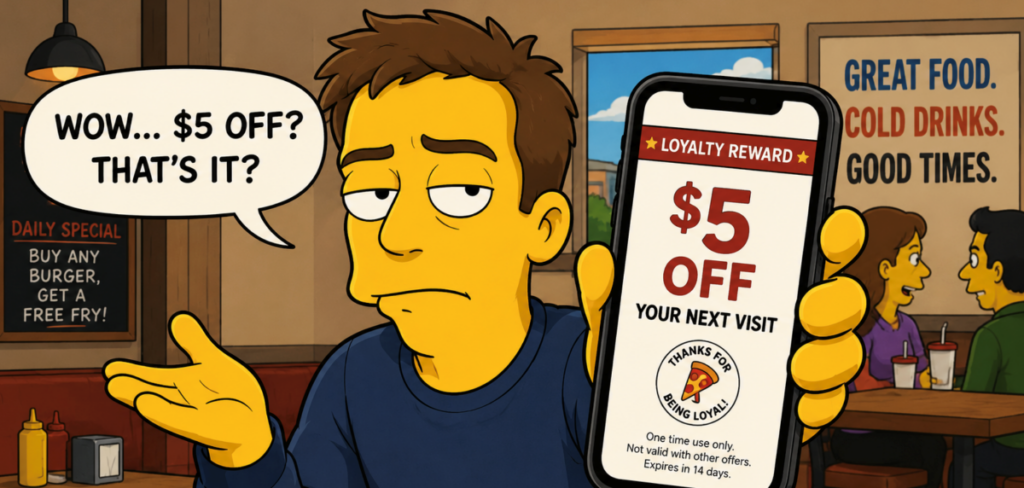
I saw a restaurant the other day offering $5 off to join their rewards program. Come on. I could have the best meal of my month in your dining room, and when your server says “Scan this for five bucks off,” I’m not exactly fired up.
Language matters. “Your next visit is on us” hits completely different than “$5 off.” Fifty percent off sounds like you’re halfway to free, even when $10 off is the bigger number. Your job is to find the offer that makes people feel stupid for not taking it. It may be a free entrée, a free birthday reward or a free appetizer—something with real gravity.
And your staff has to believe in it, too. If your cashier thinks the offer is weak, they’ll pitch it like it’s weak. Give them something they’re excited to hand over, and you get more sign-ups without begging.
Key #3: A Win-Back Program Built Around the Customer’s Cycle
Most win-back programs are shallow. Somebody misses a visit, they get one reminder, and then the software gives up. That’s a miss.
The good ones track the missed-visit cycle around each customer’s actual rhythm. If I hit Blazioli’s every seven days and I don’t show up on day seven, on day eight I should hear from them. But if Shaheen comes every 14 days, reminding him on day eight makes no sense. He hasn’t missed anything yet. So ask your system: How are missed visits tracked, and how many win-back cycles can you run? Three to five attempts in a 60- to 90-day window is a strong effort.
Then make the offers escalate. If Mike hasn’t been in for 50 days, my bribe in week five better be bigger than my bribe in week one. A buddy of mine once said he wanted a program where missing one cycle earned a free burrito and missing 10 earned 10 free burritos. I still want to watch someone walk in and claim all 10, just so I know we got them back.
And do not lean only on the software. The phone in your pocket makes calls. If a guest came 30 times last year and then vanished for two months, pick it up. Ask, “Hey, did we do something wrong? Haven’t seen you in a bit.” Half the time, they moved. The other half, you just saved a regular.
Key #4: Smart Offers That Change the Spending Habit
Ten years ago, LaRosa’s Pizza ran a promo where you downloaded the app and got three free cookies. I took the bait, figuring the cookies would be nothing special. They were fire. Now, I buy cookies every single time I go. That’s the whole idea behind a smart offer: Give someone an excuse to spend a little more and try something they’d never have tried.
Here a breakdown, working with real numbers: One segment of customers was averaging about $31 per ticket. A campaign went out: Spend $48 or more and get double points—no free food, no discount, just points. Those guests jumped to around $80 per visit. To hit the threshold, they added wings, added a dessert and discovered new favorites, which resets what “normal” looks like on their next trip.
Across all 10 customer segments, that one campaign drove 106 orders and a total spend bump of $5,257. That’s five grand these guests would not have spent without the nudge. Your only cost is food; at 30% food cost, that’s roughly $1,500. So you just cleared around $3,000 in incremental profit and rewired your best customers to spend more in the future.
Key #5: Survey First, Five-Star Review Second
Restaurants don’t ask for reviews enough, and the ones that do, often do it backward. They email every guest a “leave us a review” link. But what if the visit stunk? You just handed an unhappy customer a megaphone on your Google profile.
Survey first. After a visit, loyalty sends a short survey. How was it? If they rate it five stars, then you send the review link—and send it to one platform, not three. Pick the one place you need the most love. If they give you a four, thank them and move on, because a four actually drags down a profile you’re trying to push toward five. If they give you a three or below, call them and fix it. One restaurant sat at 4.8 inside their loyalty system while their public rating lagged. Once they funneled only the five-star crowd to the right platform, the public number climbed.
Do the Math, Then Do the Work
I talked to a Dominate-level client this morning. He uses Toast POS and Dryver loyalty, and he’s three years in. His loyalty program accounts for 29% of monthly sales—it’s humming. But 70% still comes from everything else, which is exactly why loyalty is one piece of a bigger plan, not the whole plan.
And it compounds. One client did $16,222 in loyalty sales in January of 2022. They got serious about growing the database in 2023, leaned in harder in 2024, and three years later that same program does more than $40,000 a month—it’s almost tripled. This comes not from raising prices, but from adding people and pulling the right levers.
Here’s the one thing to do today: Go pull your restaurant’s Google rating and your review count, and do the math on what it takes to move it. If you’re at a 4.3 and you stacked 15 five-star reviews a month (one every other day), you’d be climbing toward a 4.5 within the year. Then build the SOP to actually ask for reviews, starting with your loyalty database and the guests who already love you.
Take our free WIN Audit to see exactly where the gaps are in your restaurant’s marketing. And if you want to go deeper, join our free ABR Skool community, where we help owners and their teams dominate all nine strategies under the ABR pillars.
I’m Matt Plapp, the CEO of America’s Best Restaurants, and we exist to help independent restaurant owners win, not survive. We help them win through their marketing and by leveraging our three pillars: Attract Attention, Build a Database, and Retain Your Customers. The goal is to win new customers, win back lost customers, win more frequent visits, win higher check averages, win your community’s attention, and win against the chains.