

By Charlie Pogacar
When Mulberry Street Pizzeria agreed to open a location inside Resorts World Las Vegas in 2021, it began a new adventure. With four iconic and corporately owned locations in Los Angeles, opening in Las Vegas would not just become a new city to operate in—it would also signal a format of growth: licensing.
The location would be owned by Resorts World but created in tandem with Richie Palmer, the well-known purveyor of pizza who founded Mulberry Street Pizzeria in 1992. The licensed store would use Palmer’s recipes, branding and other intellectual property, but it would be staffed and operated by Resorts World.
But Palmer had something of an ace up his sleeve: his nephew, Darren Tripicchio, who had worked in Mulberry Street’s Los Angeles locations. Tripicchio wasn’t even of legal drinking age when he first moved from Westchester County, New York, to Los Angeles. He also hadn’t originally planned on building a career in restaurants. But after falling in love with the business—and with Mulberry Street Pizzeria—he eventually became the natural bridge between a fiercely protected pizza culture and the new licensing format.
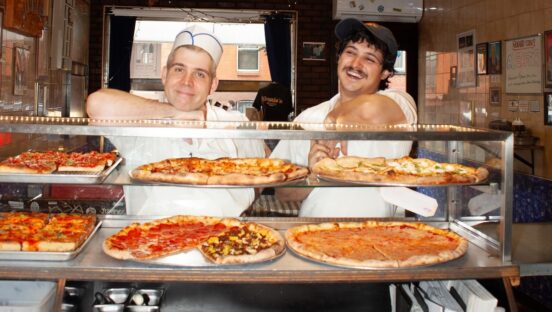
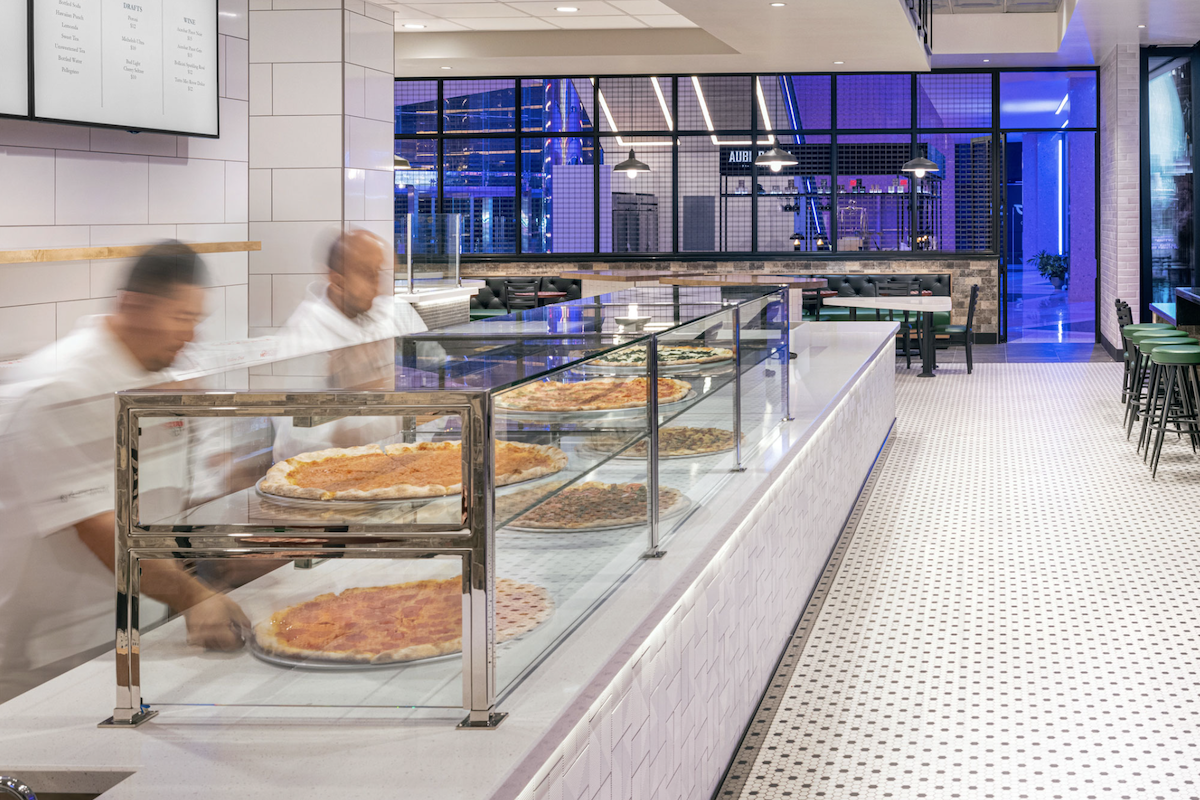
Tripicchio now oversees a store that looks a lot like its four predecessors. The details are all there, from the framed celebrity photos and memorabilia on the walls to the oversized pizza display case up front, lit so the pies glow behind the glass.
Tripicchio said that continuity was intentional. “We wanted it to feel like Mulberry, not like a hotel food outlet,” he said. “The idea was that when someone from L.A. walks in, it feels familiar. And when someone from Vegas walks in, it feels like a place with a history.”
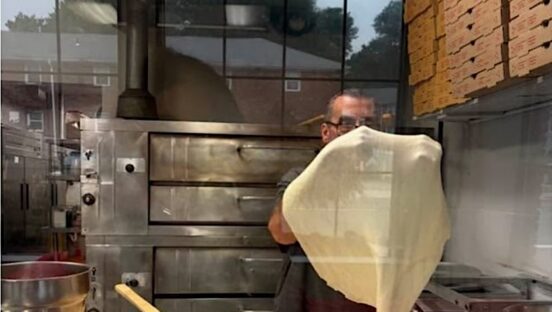
Even the layout reflects that thinking. The kitchen is stripped down to its essentials—a single production line with deck ovens—keeping the focus on speed, consistency and the pizza itself, rather than a sprawling back-of-house operation more typical of casino restaurants.
Before Tripicchio was installed as a manager in Las Vegas, he spent months perfecting pizza making in the L.A. shops. He knew if he was going to do justice to the Mulberry brand, the pizza would have to taste as good in Las Vegas as it did in Los Angeles—and he took great pride in mastering “real New York pizza,” as he calls it. (The difference? New York-style pizza is an imitation of the real thing, Tripicchio said—and the real thing is New York pizza).
But no preparation could’ve prepared Tripicchio and his team for some of the challenges they’d encounter at Resorts World. Unlike Mulberry’s neighborhood shops in Los Angeles, the Vegas location sits inside a destination resort that is not organically connected to Strip foot traffic.
“It’s really a place you have to want to go to,” Tripicchio said. “And because the restaurant is owned by the hotel, you don’t really have funds in your hands to be able to market. You’re very dependent on the hotel’s success.”
That was just the start of the differences, too. One of the most costly issues centered around prep work. At Mulberry’s Los Angeles shops, the team slices its whole-milk mozzarella in-house—a detail that Palmer considers part of the soul of the pizza. In Vegas, however, the store’s physical footprint and permitting restrictions made that impossible.
“Our kitchen is basically one line with ovens and a small dish pit—that’s it,” Tripicchio said. “We couldn’t put in a slicer. We had to rely on the hotel’s prep kitchen.”
And that was costly, to the tune of $20,000-$25,000 per month. Once Tripicchio dug into the numbers, they were hard to stomach. So he brought an idea to Palmer, one that would need his blessing: switching from sliced mozzarella to pre-diced Grandé. It was the same cheese, sourced from the same supplier—but in a format that eliminated prep labor, transport and most of the allocation burden.
“Now our allocation is [a fraction of what it once was],” Tripicchio said. “It fluctuates, but it’s nothing like it was.” The change required careful testing to preserve Mulberry’s signature balance, but Tripicchio says guests never noticed a difference. “People from L.A. come in and say, ‘It’s just like home.’ For us, that’s the biggest compliment.”

Because the hotel houses a nightclub and hosts major events, demand arrives in waves. On peak nights, the store can move more than 1,500 slices. On quieter weekdays, volume drops sharply—a very rhythm different from a neighborhood storefront.
That volatility, Tripicchio said, has shaped how he thinks about the business. “I can’t control how busy the hotel is on a Monday,” he said. “But I can control our margins. That’s the job.”
In this way, Tripicchio is forming his own legacy in the pizza business, one he hopes snowballs into something bigger. He’d like to one day open more licensed Mulberry locations in other areas. For him, the Resorts World location was a proof of concept, one that suggested a Mulberry Street Pizzeria can work just about anywhere—hurdles be damned.
“I’ve got big ambitions for our business,” Tripicchio said. “I really do, and I’m faithful that if we have a great product and we stick to what we do best, we can really expand. That’s something I’m really looking forward to.”