
By Tracy Morin and Fabio Errante
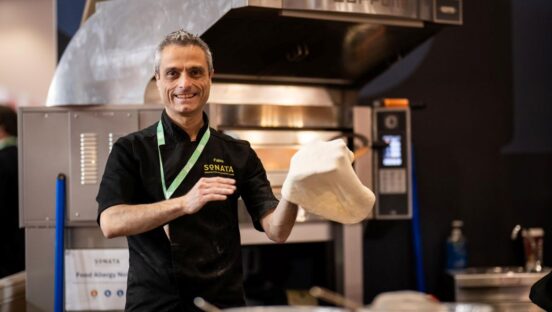
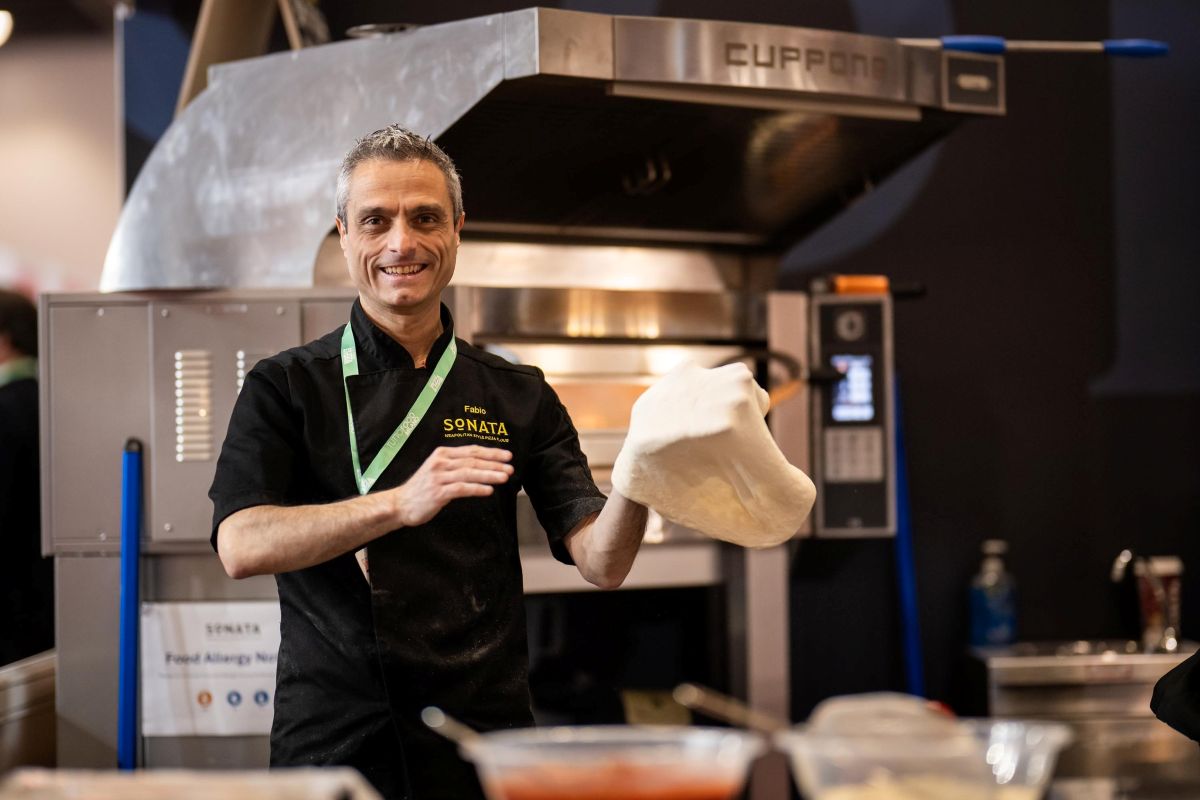
“If you ask pizza lovers around the world, chances are that they will mention 00 flour as one of the must-haves in their arsenal—some kind of secret weapon that, on its own, will magically make their pizza better,” says Fabio Errante, a pizzaiolo, YouTube personality and author of Fabioulous Pizza, a handbook for the beginner home pizzaiolo, and The Fabioulous Story of Pizza, a novel about the history of pizza. “As much as I’m happy that a product that comes from my country is so loved and revered by the pizza community, it’s also true that I myself don’t obsess about using 00 flour.” Here, Errante clears up some common misconceptions about this popular pizza ingredient.
Demystifying 00 Flour
Errante’s reality check: A law regulates the nomenclature of Italian flours, and it’s important to know how it reflects (or doesn’t) on the quality of the flour. “It’s not as if, one day, an Italian miller decided what to call flours,” he explains. “An actual law, the Decree of the President of the Republic (DPR) #187, issued in 2001, defines what you can call farina di grano tenero (soft wheat flour) and its qualities. But the law doesn’t mention granulometry, ideal use or recommended temperature to cook a product made with 00 flour.”
Errante notes that the core of the DPR 187 is a table where the five types of farina (flour) are mentioned, along with their defining features, including the maximum amount of humidity, the ash content range and the minimum protein content. “For any flour to be called 00, the max humidity must be 14.50% (although 15.50% is tolerated, as long as it’s explicitly declared), the ash content 0.55% and the minimum amount of protein 9%,” Errante says. “Let’s look at this last detail for a moment: 9% protein. I have never heard of any pizzaiolo who would want their flour with such a low protein content.”
Errante points out that a pizzaiolo typically seeks a higher protein for flour, due to the fermentation process. “We all know how good it is to ferment our dough for a long time,” he says. “It’s fair to say that an average bread flour has at least 11.5% protein, enough to withstand a relatively long fermentation. The low protein alone would be enough to ditch any 00 flour and conclude that it’s not a good choice to make pizza—it could make pasta or a nice cake instead. Of course, there are 00 flours with a higher protein content, but that has been decided ‘upstream’ and engineered by millers and farmers, with an influence from the weather. The actual commercial name of the flour has nothing to do with it.”
In addition, the DPR 187 defines five types of soft wheat flour: after 00, there are also 0, 1, 2 and farina integrale di grano tenero, which is wholemeal. “This classification is from the highest to lowest level of filtering, so 00 is the most filtered, and it contains just the endosperm of the wheat kernels,” Errante says. “Then 0, 1 and 2 are less and less filtered, and they contain an increasing amount of wheat germ and bran. And, finally, integrale (wholemeal) is not filtered at all—therefore, it has a darker color.”
It’s this fact, Errante believes, that lies at the root of a widespread misconception, which can persist even among Italian pizzaioli—that 00 flour is very finely milled. “I reckon that this comes from the different tactile feeling we get when touching 00 as opposed to wholemeal,” he says. “When we feel the bran particles, we perceive it as rougher than 00. But that’s just a deception of the senses. The size of the single grain of flour is decided at a previous stage of the milling process, not during the filtering. This phase, which takes place in a machine called Plansichter (or Plansifter, in English), is simply to determine how much bran will be present, and consequently the ash content. And this leads us back to the table shown in the text of the DPR.”
While Errante clarifies that not every flour is milled the same way, and flour with finer grain does exist, granulometry is not unique to 00 flour. For example, there are bread flours or all-purpose flours that are milled finer than 00—and they are not out of the ordinary.
Is 00 Flour Always the Best Choice?
“Another common narrative around 00 flour: It’s considered high-quality just because it’s Italian,” he says. “But I feel this is not necessarily true. In Italy, we produce just around 35% of the soft wheat we need, so we rely heavily on imports from abroad to meet our needs. By law, flour sold in Italy is considered ‘Made in Italy’ if the last significant processing happens on Italian soil, even when the wheat itself comes from another country. Basically, the label tells you where the flour was milled, not where the wheat was grown. Usually, this information is not the easiest to find.”
Therefore, a certain crop of wheat from, for example, Canada, could be milled locally to create a bread flour with 12% protein. But it might be sent to Italy instead, then transformed into a 00 with the same 12% protein. “Why should we consider this 00 better than bread flour made with the same raw material?” Errante asks. “Of course, this is an extreme example—it doesn’t take into account the whole process—but I think it’s fair to say that those two batches of flour are very similar, despite their names being different.”
Errante’s main takeaways: Tipo 00 flour is not necessarily higher quality just because it’s Italian. It’s not always ground more finely than other flours. And no one should feel forced to use it to make a great pizza. “The denomination alone says very little,” he says. “Let’s look for the details we should actually care about, from the protein content to the origin of the wheat—not just where it was milled. The real secret weapon was never the 00 printed on the front of the bag. The numbers on the back are way more important.”
Fabio Errante started making pizza when he was a kid. “I was always obsessed with pizza—to the point where, in 2012, I quit my corporate job and went to work at the pizzeria full-time,” he says. “I worked in four restaurants, both in Italy and in London, moving all the way from the position of total newbie to head chef. Because I believe in a beginner’s mindset, I still listen to pizza maestros, buy courses, attend master classes and read countless books about baking science. As an instructor, I need to back up my teachings with actual knowledge.” Find him on YouTube at fabioulouspizza.