
By Tracy Morin
In business for 52 years, Spinato’s Pizzeria & Family Kitchen, with seven locations in Arizona, clearly knows how to survive—and thrive. But Anthony Spinato, CEO, also knows how to think outside the box, and he has secured marketing gold for his brand through numerous sports team partnerships. First serving as the official pizza of the Phoenix Suns and Phoenix Mercury, Spinato’s has also been the official pizza of the Arizona Cardinals since 2024, serving its pies in the concessions stands.
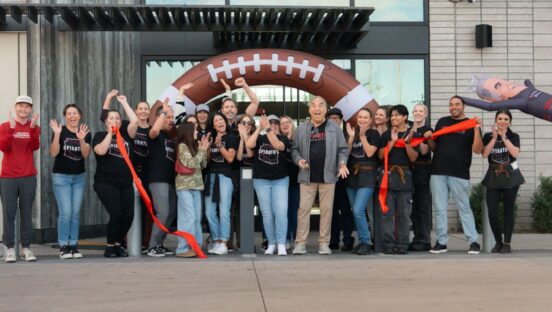
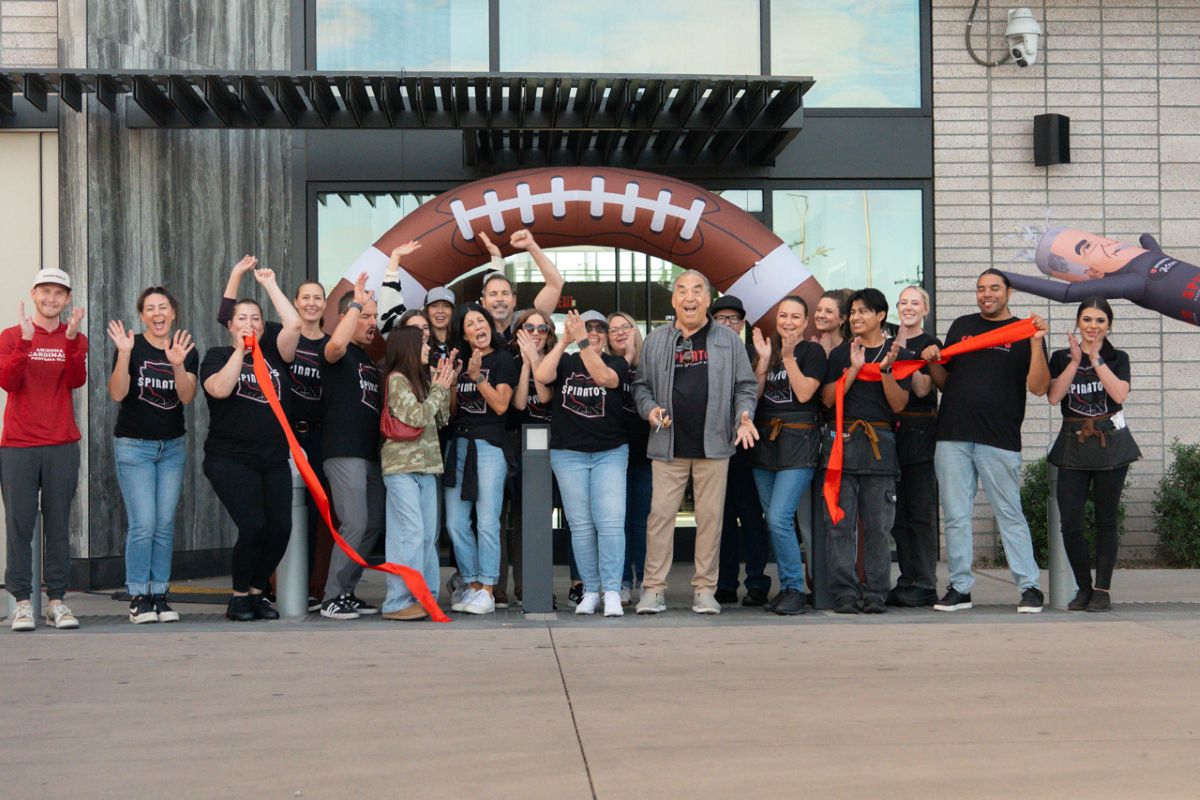
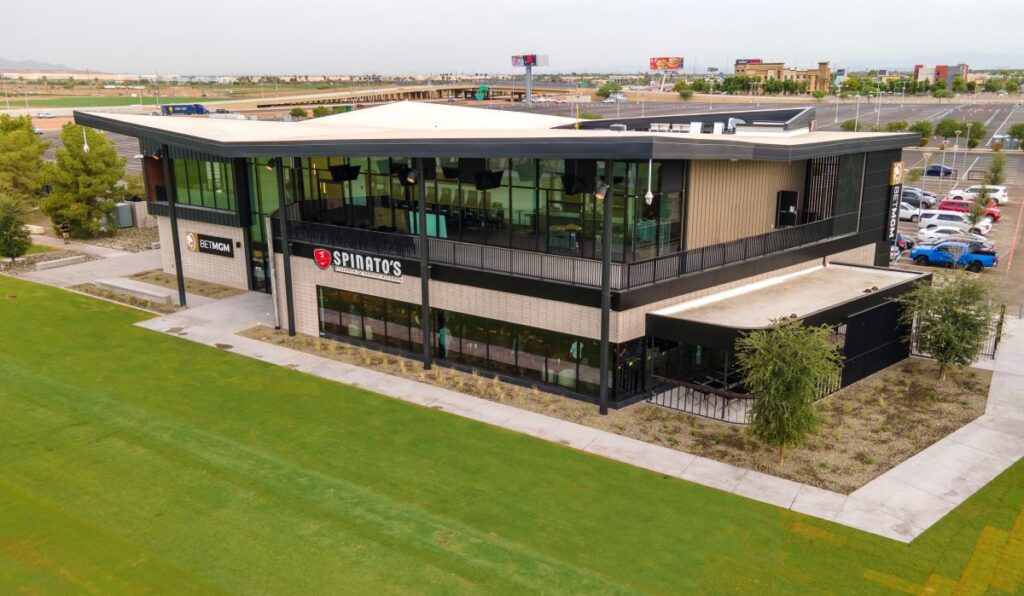
But Spinato’s latest endeavor is unusual, even for a brand with such strong sports ties: opening a two-story, full-service restaurant across from the State Farm football stadium, inside the 17,000-square-foot BetMGM Sportsbook. The grand opening party, held on November 22, points to an enthusiastic reception, as crowds gathered for an Arizona Cardinals Watch Party, appearances from Arizona Cardinals cheerleaders, a ribbon-cutting ceremony, food and drink specials, games, and raffles for Arizona Cardinals game tickets and other prizes.
But the question remains: How does an operator make such a partnership work for his business—in terms of marketing, staff and, of course, the bottom line—when teaming up with established giants like big-league sports teams? Can it even be done? Spinato says yes—and in this exclusive interview, he shares how to ensure the partnership can work well for a family-owned pizzeria.
PMQ: From your extensive experience, what advice would you share with other owners who are getting involved with a sports team, whether it’s a major name or a small local team?
Spinato: First, let the excitement of the opportunity wear off before you go into that negotiation. The opportunity is magnificent—you can get your name and your brand in front of millions of people. That’s something you have to figure out: What is that worth to me? You have to really think about the opportunities and how this could impact your business, and then what you would have to spend to get yourself in front of this many people. That’s what we had to do. I had to ask my marketing director, based on the data and statistics, how much would we have to spend to get in front of this many people?
Instead of just having a sponsorship saying we’re the official pizza of the Arizona Cardinals, they actually get to serve our pizza. To us, that’s one of the strengths. When people go into an arena, if they’re a pizza person, a burger person or a chicken person, they’re going to get pizza, a burger or chicken. It doesn’t really matter what the brand is. I thought it was a great opportunity, because they could go to some of our other local pizzerias. At least they’re going to try my pizza one time, and I have a chance at conversion.
We had to go into it with that understanding first, because I didn’t know if this was going to be a loss, break-even or a little bit of a gain. I had to ask myself, if we lose $100,000 on being a concessionaire, is that $100,000 worth of value in terms of the marketing? That’s the first thing I would look at: What does it cost?
Second, there were owners who were willing to talk to me. I had to go around and ask before we did any deals. I would say, “Do you happen to have an owner or a local partnership group?” I was able to talk to enough existing concessionaires who could tell me what to expect. Some were willing to share what their split percentages were. Others were keeping things confidential, but they said you could expect between this and this. It helped me go in knowing what financial opportunity or outcome we could get. Then I was able to figure out how many pizzas I would have to sell to break even, just so I knew what that looked like and whether it was even possible.
The next thing I did was ask for data. They’re always willing to share data. I said, “The existing incumbent that’s there now, can you share with me how many pizzas they sell out of each concession?” Knowing what I knew about the Suns partnership, we sold 35% more than the incumbent we took over in that partnership. So [for the Cardinals] I took a conservative approach and asked, “If we sold 25% more pizzas, what would that look like?”
I looked at it financially first because, as a restaurateur, we’re dealing with single-digit margins in terms of profitability. I can’t take marketing losses where I just say, “If we lose $300,000, it’s still worth it because of the exposure.” I can’t chalk it up like that. I really had to understand the financials more than anything before I threw my hat in the ring and said, “Let’s talk.”
Then it was all the details: Who’s making what? Do I have control over making my pizza? Because I don’t want anybody to touch it. I want our staff doing it. You have to think about what you’re trying to protect. If you’re a food and beverage provider, you’re trying to protect your product.
We also wanted to make sure what the live experience was. As a fan, when you walked up to order a pizza, you weren’t just getting a generic interaction. We wanted to make sure people were welcoming and that customers felt appreciated, because they are the reason our team members have a paycheck. We talked a lot about that. I wanted to make sure we could protect the non-negotiables in our organization, which are our food, how we serve, the experience and how we treat people. If you were to walk into our restaurant, it should feel the same way as if you walked into our home.
I think it should be very clear what you need to protect. What are your non-negotiables? Then give yourself more time and have more conversations. It’s not a two-week process where you say, “I think I have the information.” We had multiple calls. Then we would say, “Give us a month to sleep on it, pray on it and discuss it as a team.”
More questions would come up. We would ask, “What about this? What happens if there’s a game on Christmas? We don’t open our restaurants on Christmas. Does our team have to work? Can we just close the concessions down?” The answer wasn’t necessarily that you could close. There was an expectation that, as a concessionaire, you always have to be open. Then it came back to our organization: Is this a non-negotiable? If our team does have to work on Christmas, what are we going to do for them? Rather than just saying, “You get paid,” do we pay double time?
We had to understand all those things that already existed within our culture, the things we could control and protect. We had to figure out why we would say yes if we had to do it this way, what would be the right thing to do for our organization, how to support our team members, and how to make sure this was right for us.
It took us three to six months, probably closer to six months, on this negotiation. It wasn’t about pushing back and being hard on them. It was more about consuming information, figuring out what other answers we needed to know, identifying the questions we hadn’t asked, and making sure we had worked through the opportunity. We didn’t want to go into this blind and find out things down the road when it was too late.
I still feel that we’re a small family business. I’m a native of Arizona, and when you’re asked and invited into an opportunity like this, it’s almost something you can’t even imagine. You could have never dreamt it up. A lot of the advice I got from my mentors was to let the excitement of that wear off so you can approach this as another business opportunity. You need to make sure it’s right for your business and that you can live with some of the things you may not love, but that you also get enough of what you need to make sure it’s a good decision.
PMQ: How did the partnership with the Arizona Cardinals come about? What does working with a sports team entail, how has the partnership evolved, and what opportunities and challenges have come with it?
Spinato: This was quite an opportunity, and it took a lot to get here. But this wasn’t ever really on the vision board for Spinato’s. To give some context, we are the official pizza of the Phoenix Suns and Phoenix Mercury. One of my really good friends is a business mentor, a guy who has done more in his lifetime than I could ever do in 10,000 lifetimes. He’s also a longtime guest. When these opportunities come up, I talk through these things with quite a lot of people, take a lot of direction and listen.
He said [about the initial partnership opportunity], “If this works out and you say yes to the Phoenix Suns, it’s going to open up opportunities that you can’t even envision or imagine.” I always go back to that moment and the wisdom he had, and that led to the Arizona Cardinals sponsorship that we started just a couple of years ago, where we started as a concessionaire inside State Farm Stadium. A few years later, here we are with the Arizona Cardinals [in the BetMGM location].
I’ve known the Cardinals’ COO, Jeremy Walls, for a long time. He’s grown up in the sports industry, worked his way through different sports teams, went to the Miami Heat, and then ended up taking over the Dolphins. He came back out here, where he lives with his family, and he’s a longtime guest at Spinato’s. When he landed, he was the one who said, “Hey, we would love to have you do pizza inside the stadium.” That’s really how the partnership got going.
PMQ: What do you think drew him to Spinato’s?
Spinato: What they saw from their perspective was an owner and an executive team at Spinato’s that was so involved in ways they had never seen another concessionaire be involved. I’m down there on Sunday mornings at 6 in the morning, starting to prep, roll pizzas, make pizzas and work the stands. Our district managers and company trainers are also very involved in that process.
As a concessionaire, if we’re going to do this, we’re going to treat it like one of our restaurants. We want to be able to work with our staff. If there’s a game day, I’d like to go down there so I can work and be involved. The running joke was, “Every time we go down and want to have a talk with Anthony, he’s got to take off his apron and wipe the flour off his shirt.” That really was why they asked us to take on this partnership.
At BetMGM, there was a restaurant on the Great Lawn, and they weren’t happy with that restaurant operator. It was originally supposed to be a steakhouse, and they wanted a partner who was passionate and would give people a reason to come out. It was a beautiful restaurant with a beautiful view of the Great Lawn. That’s really how they selected Spinato’s: our involvement and how we approached our partnership inside the stadium.
They approached us and presented the idea to us. It wasn’t necessarily, “Heck, yeah, let’s do this.” Our team was more, “Wow, this is different.” We were sharing a space with BetMGM. They’re in the building, and there were questions about their hours and the expectations for us. There was an existing restaurant there that had a contract with BetMGM to be the food and beverage provider. We needed to be there to support BetMGM’s business, in a way, and then you had the Cardinals, who wanted Spinato’s in the space. You had a couple of different entities that all had different needs and goals. It created one of the most complex partnerships to figure out. How were we going to do this?
BetMGM needed certain things from us. The Cardinals wanted us open at a specific time. We had specific hours. At Spinato’s, we don’t stay open on holidays, and we have a quality of life that we provide for our staff. It was a matter of figuring out how we could all make this work for each other.
Then we had to build out the space while the existing restaurant was still operating. That was another complexity. They had restaurant hours, and we had to get in there early in the morning or overnight sometimes. BetMGM has security in the building, so we had to go through their security and make sure we were even allowed in the building. The planning and communication were unlike anything I’ve ever had in any sort of restaurant construction project, because there were basically four entities that had to be involved in every decision.
That was how this thing started: How are we going to do this? How are we going to keep everybody happy? How are we going to meet our opening timelines? And how are we still going to be Spinato’s through all of it?
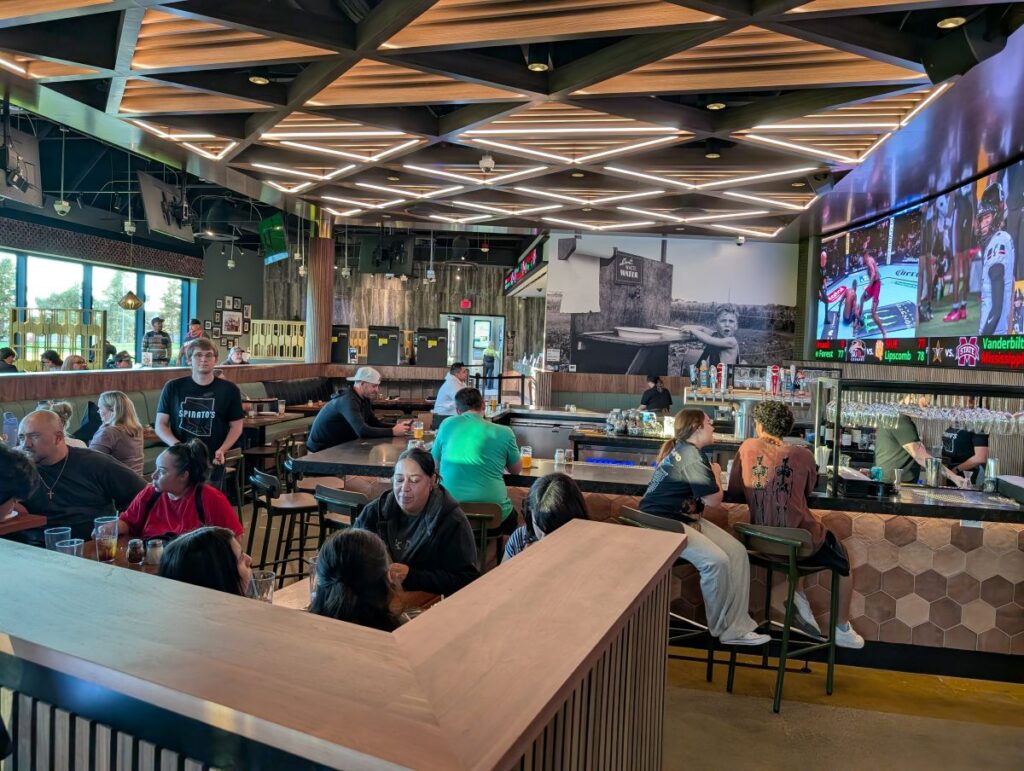
PMQ: What were some considerations you had to keep in mind with the newest location?
Spinato: The sponsorship works from the inside of the stadium, since we serve all the fans. On game day, everyone can come in and get pizzas at one of our four stands. But the new restaurant is on the grounds, outside the stadium.
I spent a ton of time with the previous restaurant operator, who was gracious enough to give me a ton of their time. I wanted to understand what the greatest things about this were and what the worst things were.
On game days, nobody can get into the restaurant as a normal Spinato’s guest. That means our audience is everybody on the lot—anybody [among them] who wants to come to the pizzeria that day. Then there are concerts and events. They shut down the parking lot at certain times, so there can be some really unusual operating times when you have to close down to the general public. You’re basically opening your doors to whoever is on the grounds.
From a revenue standpoint, it’s different than how we normally staff and operate our restaurants. If there’s an event, we’re going to get slammed for three hours straight prior to that event. Then we have a ghost town in there. It might be a Friday night at 7:00, but if the event started at 6, we have no guests. We were working through questions like: What are our hours? How do we staff that? Do we even change our hours?
We’ve kept our menu prices exactly the same. We’ve been advised and supported by the Cardinals and everybody else to raise our prices on event days, because it’s a very high-demand place to be. We look at it like this: Yes, it’s high demand, but we’re also operating seven days a week. Why would I charge 15% or 20% more for my pizza on this specific day when that same guest would pay less if they came in on a regular day? We were talking through a lot of these things as an organization and figuring out what’s best.
We do lose revenue on days when there are events, because we can’t have a normal Friday night of business. Then there are peak weeks when you’ve got several events going on and you’re slammed. We had a car show out there for two and a half days, followed by a game the next day. In three days, we did about a week’s worth of business. So there are lots of different challenges, and those were the things I wanted to talk through with the original restaurant operator.
The reason the Cardinals wanted us to be the restaurant operator in that place is that they know we bring people out. We have food that brings people together, and they wanted people on the grounds and in the space seven days a week versus just on an event day.
PMQ: In terms of being the official pizza of the Arizona Cardinals, what does that actually entail?
Spinato: We had the choice to take over a concession and just sell pizzas out of there. You could do that, but we weren’t really going in there just to sell pizza. We wanted to continue to build the brand and the name. We wanted to be seen and known as the official pizza of the Arizona Cardinals.
What you have to do after that is treat it as a marketing cost. You have to be able to put that on your box, your window and your shirts. We have radio ads to say we’re the official pizza of the Arizona Cardinals. There is an annual sponsorship fee, which is just a marketing expense to the organization.
The ironic thing is that if we don’t do that, another pizzeria here locally could basically buy the rights to call themselves the official pizza of the Arizona Cardinals, even if they weren’t a concessionaire in the stadium. From a partnership standpoint, and because we were going to do this, we wanted to be both. With that comes the feeling that we’re invested in them, and in return, they’re more invested in us. I’ve seen and felt all of that as we’ve opened this latest restaurant.
We opened it somewhat softly. It wasn’t a normal Spinato’s pizzeria opening, where people see you build something out for several months, it’s on the corner of two streets, and all of a sudden you open the doors and have a floodgate of people.
We opened this restaurant in the middle of a big parking lot on the west side of the stadium, outside the stadium. It’s more about getting people to know that we’re there. When we opened, we were slower than expected. I let the Cardinals know. I said, “This is an unusual opening for us. We knew it would be challenging, and we knew we would have to work at this, but we’re below what we thought we would be. Because there’s a freeway close by, but there’s not a lot of visibility.”
The Cardinals jumped in and said, “Let us help you. Here are the things we can do to market your business and the restaurant.” They wanted to put us on the billboards, the big monument sign, the digital boards, and everything they possibly had access to. Out of goodwill and support, they’re helping drive traffic and awareness.
When they asked us to take over this restaurant, I said a couple of nos—I wasn’t sure if this was right. [Cardinals owner] Michael Bidwill sat down with me one on one and said, “What is it going to take for you to say yes? Because you are the one person we want. We’re not asking anybody else to do this. What is it you need?”
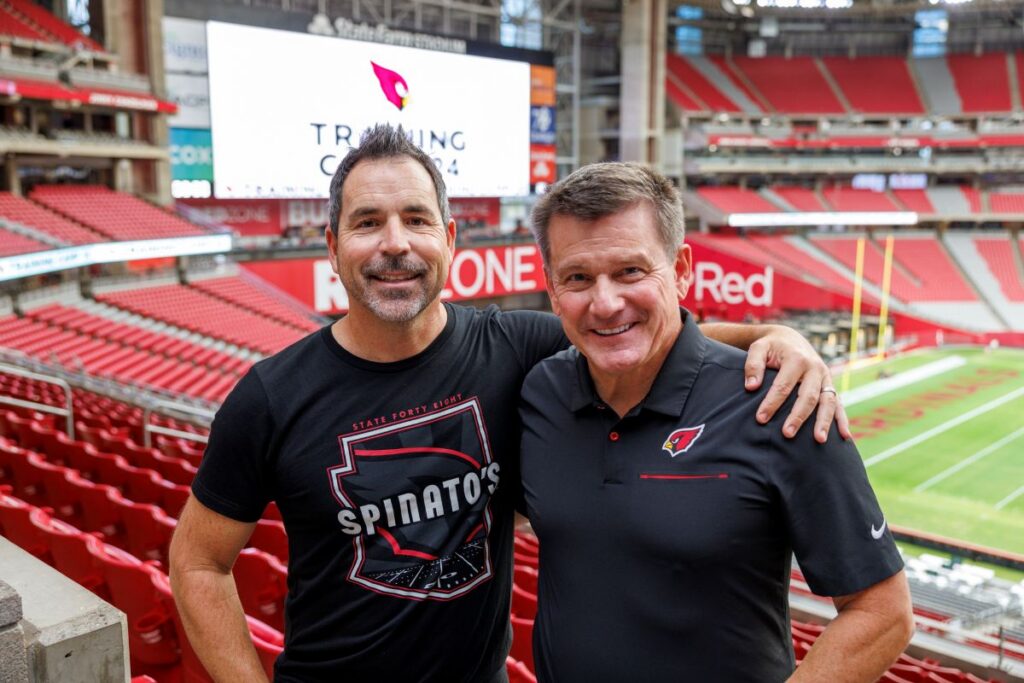
I really felt that partnership. The Cardinals are also a family business, and we connected over that. He said, “You probably don’t think of it this way, but I also run and lead a family business, so I know what it’s like.”
I told him there was so much I worried about when it came to taking care of our family and making sure this was right for our family. We needed more time. We didn’t want to do it in such a short time. We don’t like to open restaurants one after another, and we had just relocated our North Phoenix location. I told him I needed support in certain areas, and he said, “It’s done.”
I think that would have happened anyway. I believe that’s the kind of guy he is. You felt a true partnership coming back through this process, as difficult as it was.
PMQ: So you found the concession business inside the stadium lucrative enough to encourage you to explore other opportunities with sports teams?
Spinato: It’s beneficial. This is something that will be good for other operators to know: When we took on the partnership with the Suns and then with the Cardinals, what we saw was that in year one, you’re the new concessionaire. In both of those partnerships, with the Suns and the Cardinals, we are their highest-grossing concessionaires. We’ve been very, very effective at what we do.
We make fresh-cooked pizzas. They’re not in hot boxes or anything. We’re very into the data, what we sell and when, so pizzas are literally coming out of the oven, we’re cutting them, and then you’re taking them to your seat.
What we found is that in year one, everybody wants to check you out. In any contract with a sports team, you’re going to have the most sales that you’re going to have [in year one], because you’re new. Then you kind of flatten out over year two.
In addition to that, you see the residual business in your restaurant. At the time, we had six restaurants, and now we have seven. We saw some growth in the restaurants the year we did the Suns and Mercury partnership, and then we saw some additional growth when we did the Cardinals.
But after year two, you also flatten out in the restaurants. Any new business you got from that is already baked into your year before. It can be lucrative, more so in year one, and then you settle into where you’re at. It really ends up depending on your marketing fee, which is the sponsorship investment to be the official pizza.
They also take a percentage—and I don’t want to disclose what that is, because every concessionaire negotiates their own percentage. But they take a percentage of your sales inside the stadium, and that goes toward their operation or overhead.
With beverages, such as beer and soda, they give us just a small amount, because we’re only serving it. The way I would explain it is that anything that’s proprietary and we make ourselves, we get more of the profit share, because it’s our food and our preparation. Anything else, whether it was candy, popcorn, soda or beer, they get almost all of it.
They also set your prices. As a concessionaire, it’s a little different than taking over my own restaurant on the grounds. At least I have control of my entire restaurant. With a concession, they’re saying, “We have these other concessionaires in there. We don’t want you to undercut them in pricing. We don’t want you to be too high. We want to be a value to the fans, so we’re going to put you right in this range.”
For example, if a pepperoni pizza is $14.50, we make less than we would selling that pizza in our own restaurant, even though it’s around $9.50 or $10 there. They take a cut, and then we get the remainder. It might sound or look lucrative because you’re selling all these pizzas for $14 or $15, but we’re only getting a percentage of that!
Tracy Morin is PMQ’s associate editor.