By Rick Hynum | Photos by Sophie Macaluso
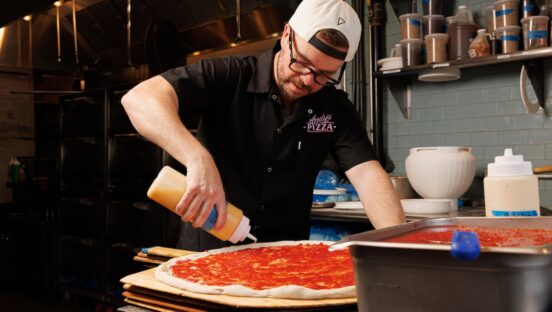
Andy Brown will be the first to tell you: He’s not some kind of Anthropic brainiac. He’s a pizza guy—and a very good one at that. So good that he has built the pizza brand bearing his name—Andy’s Pizza—into an acclaimed 14-store chainlet in Washington, D.C., Maryland and Virginia and claimed top honors in the Traditional Division at the International Pizza Challenge in 2021. In 2023, Andy’s Pizza was hailed by the Washington Post for offering the best New York-style pizza in the D.C. area, and in 2026 the Washington City Paper named it the area’s best pizzeria, period, and the best fast-casual restaurant.
So Brown knows pizza. But overseeing operations for 14 locations spread across three states is a logistical challenge of titanic proportions. Brown needed a better system, and it needed to be custom-built with his stores in mind. So he turned to AI, and the result was Andy’s OS, his own homemade platform that helps his team keep up with everything from staff scheduling and daily forecasting to opening new locations.
PMQ first learned about Brown and Andy’s OS when he was spotlighted by Axios in May 2026. We reached out to him recently to learn more, and here’s what he told us:
PMQ: So what problem—or problems—first made you want to build Andy’s OS, and what all does the system do for you today?
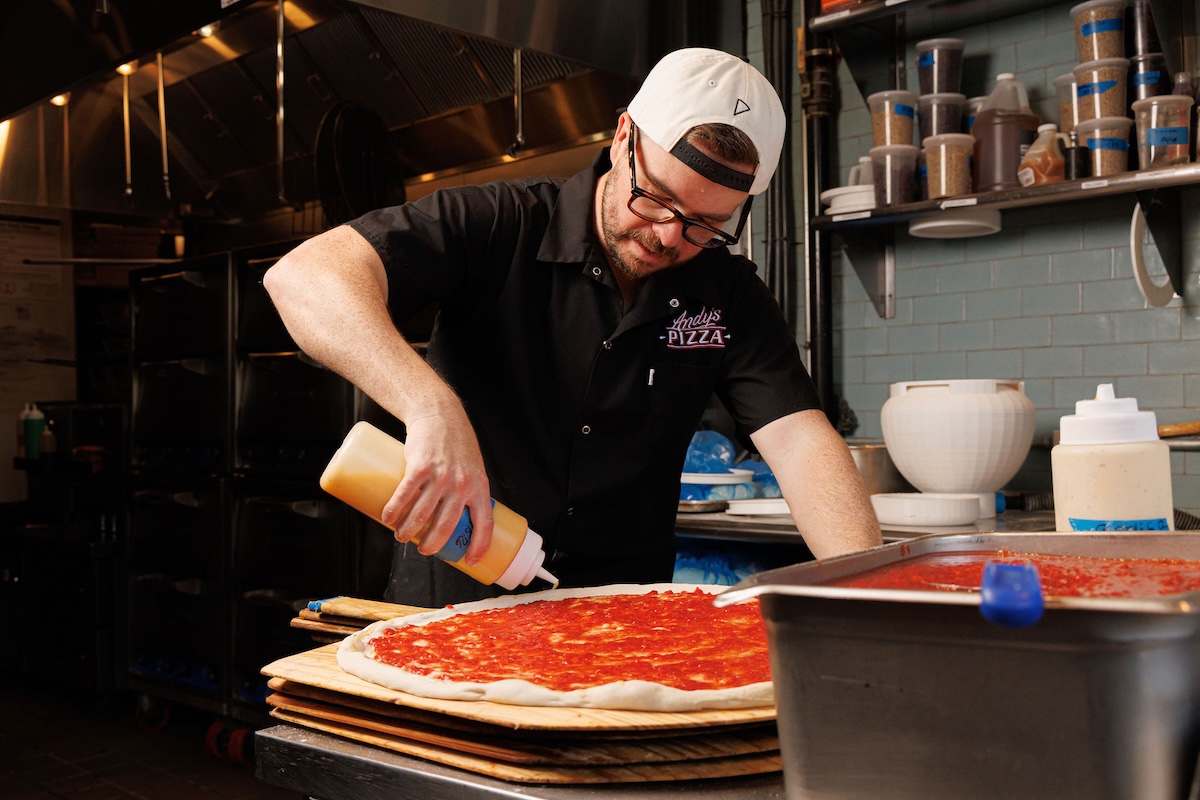
Andy Brown: It started in the kitchen. Ever since paper tickets, and then digital ones, we’ve asked line cooks to be air traffic controllers. Their job is supposed to be cooking, but they spend the shift routing orders and yelling across the line: “I’m on the Caesar, start the pizza” or “Dropping wings, fire the pie.” In a fine-dining kitchen, that’s the expo chef’s job. Quick-service restaurants don’t have one of those.
So the question was: How do we take the noise and the decisions off our cooks and give them back the time to focus on the food? Then the same question kept coming up everywhere else: scheduling, reporting, opening new stores.
Today Andy’s OS includes:
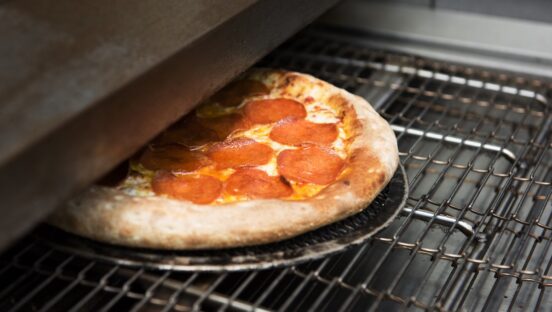
- A kitchen display system, live at all 14 of our stores. Each cook sees only the one thing they need to make next, and the system decides the order. The view screen shows our real ovens and their real status (ready, cooking, reheating) for each individual pie.
- The slice line. It watches how many separate customers are buying slices and tells the crew when to fire another whole pie for the case and which variety. The live forecast keeps our line fresh and our cashiers focused on the guest.
- Scheduling built on productivity instead of labor percentage.
- The Loop, our daily task system for opening, closing and prep, is now live at eight stores.
- A chatbot our managers can ask anything about their shift.
- Build Book, 3D models of new stores, right down to which case of gloves goes on which shelf.
It pulls data from everything we already use (Square, Toast, 7shifts, ezCater, Uber) into one place.
PMQ: That’s amazing! So why did you decide to build it—or at least much of it—yourself without a software background?
Brown: Two reasons. First, nothing off the shelf did what we needed. Our POS, our scheduling software, our catering platform, and the delivery apps each see one piece of the restaurant, and they don’t talk to each other. No vendor is going to build a kitchen screen that knows the Uber driver is stuck in traffic and that a catering order needs 32 pizzas at 6 p.m. A big chain would probably pay a consulting firm millions for a system like this.
Second, AI changed what’s possible for someone like me. I’m a pizza guy, not an engineer. With AI coding tools—we use Anthropic’s Claude—I can describe a problem the way I’d explain it to a new manager, and it writes the code.
But the code was never the hard part. The hard part is knowing exactly how your restaurant should run: how long a pie really takes, what “on time” means, which rules can’t be broken. Nobody knows that better than an operator.
It’s a huge job, but it’s ours. When something doesn’t work, we fix it that day instead of filing a ticket with a vendor.
PMQ: Could you walk me through one real-life service period where the system helps your team make decisions?
Brown: Take a typical Friday dinner. Staffing was decided days earlier. The schedule is built from how many pizzas we expect to sell each hour and how many pizzas a cook can make so that the manager walks in with the right number of people on the line.
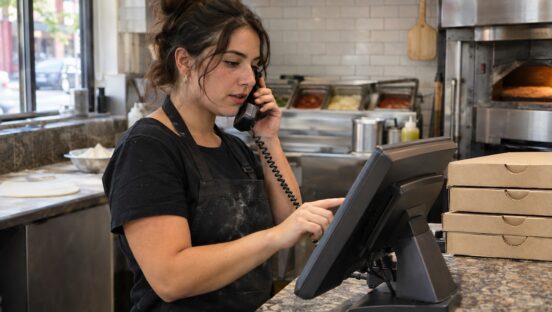
Around 5:30, orders start coming in from everywhere: walk-ins, our website, the delivery apps, a catering order. The cashier might be a part-timer who works here 10 hours a week and has a day job, and they just type “Scott 15 minutes.” Square or Toast puts that note somewhere that’s hard to see. Our system uses AI (Claude Haiku) to read it, understand that the pizza is due in 15 minutes, and slot it into the right oven so it comes out right on time.
On the line, the cook saucing dough looks up and sees one pizza and the sauce that goes on it. The next cook sees one pizza and its toppings. The oven cook sees what’s in the oven, when it will be done and when to pull it. Nobody has to call anything out. No one is looking at a ticket with 13 items, five of which aren’t even on their station, doing the mental math to make sure that order is not cooked early and not cooked late.
Then an Uber driver gets stuck in traffic and is running eight minutes behind. We track drivers live with Google Maps, so the system moves that ticket back and puts the next order ahead of it. No manager has to spot it on the Uber tablet and run to the back to reshuffle the line. Nobody has to notice anything, because the software handles it.
When guests come in to pick up an order, they see their name on the pickup board, tied to their actual pizza in the oven, so the time they see is real.
Meanwhile, on the slice line, the system watches how many people are buying slices and tells the crew when to fire another pie, so the case doesn’t run dry, and we don’t overmake and throw pizza away.
The system will even auto-pause online ordering when the shop is too busy.
PMQ: So, using Andy OS, what changes have you been able to measure so far?
Brown: The biggest change is what we measure. Labor percentage never made sense to me. If a store has a lot of long-tenured people who earn more, labor percentage tells that store to run fewer people. But they need the same number of hands in the building as any other store.
So we looked across the whole company, at every schedule and every pizza sold, and set a productivity standard. A strong cook can make about five pizzas every 15 minutes, or roughly three minutes a pie. Newer cooks are still working up to that, and the veterans balance them out.
Then we work backward: If we’re going to sell 100 pizzas this hour, how many cooks do we need for the hour to go perfectly? We add our rules on top (six-hour shifts, a manager always on site, two openers and two closers regardless of sales), and the manager gets a chart. The question isn’t “what’s my labor percent?” It’s “is my chart green?”
A store can look overstaffed during a slow lunch in Adams Morgan [a Washington, D.C. neighborhood] because it needs two people opening the front and two in the back. That’s fine. A shift is successful when we had enough people to take care of the restaurant, not when we hit a percentage.
We measure the kitchen the same way. A pizza only counts as “on time” if it’s ready between five minutes early and three minutes late of the time we promised. That’s our standard, and every store sees its number every day.
PMQ: What hasn’t worked as well as you hoped?
Brown: Reports. We have endless data now—orders, ovens, staffing, on-time—so we built a bunch of reports. Nobody wanted to read them. We’re in the restaurant business. A lot of our people don’t use Excel, and they shouldn’t have to.
But everyone uses a chatbot on their phone, so we built a chatbot. Now a manager can ask, “All my orders were late at 6:15. What happened?” It answers: “You had room for 20 pizzas, a catering order for 32 hit, plus Uber orders and web orders, so the walk-in order had to wait for an oven.” The manager gets the whole story and can make a different call next time. Pulling order timing out of your POS and comparing it with your oven capacity and your staffing isn’t something any restaurant does by hand. Now it’s as simple as being curious, and curious is one of our core values.
The other problem has been rollouts. Every Andy’s is the same, except they’re all different. When we’ve pushed a new tool to several stores at once without someone walking each kitchen first, it hasn’t gone well. We relearned that this fall when we expanded our daily task system. The software moves fast, but a person still has to look at each store before it goes live.
PMQ: During this whole process, what have you learned about how to adopt AI tools without losing the human side of the business?
Brown: We will never replace people with AI—no AI phone orders, no kiosk, none of that. The whole point is to give people their time back. Cooks should cook. Cashiers should talk to guests, not wrestle with a POS. Managers should coach, not reshuffle tickets.
Scheduling is a good example. People have kids to pick up, classes, second jobs. Managers have always had a hard time keeping track of all of it. Now, if someone requests a day off, they don’t get scheduled that day, no exceptions.
The manager can also see, based on when their team can actually work, that they’re short on Mondays, Tuesdays and Wednesdays. So when they interview someone, they open with “I need you every Monday, Tuesday and Wednesday,” and everyone’s expectations are clear from the start.
The other lesson: AI recommends and people decide. The system tells a manager the story of what went wrong, and the manager decides what to do about it. Anything AI drafts from a voice note gets checked and confirmed by a person.
PMQ: Finally, what specific practical advice would you give to other independent pizzeria owners about using AI in general?
- Start with whatever annoys you every single shift, not with an “AI strategy.” For us, that was cooks yelling across the line.
- Pick one source of truth for every number. Our net sales is whatever our POS says it is. If two reports disagree, you’ll stop trusting both of them.
- Start for free. Export last month’s sales and your schedule, paste them into ChatGPT or Claude, and ask it questions. You’ll learn more in an hour than you can get from a month of reports.
- Ask AI to do the jobs you’d never have time for. When we were planning a new store, we had it pull every manufacturer item number off our invoices, look up the case sizes on the manufacturers’ websites and lay out the shelves for our opening order. It told us we didn’t have enough refrigeration for cheese and dough before we ever got in the building. Normally that’s a “we’ll figure it out when we get in there” scramble.
- Test at one store, with someone watching, before you roll anything out. And make sure you can turn it off in a minute if it goes sideways.
- Keep people in charge. AI is great at cutting through the noise. Taking care of your guests and your team is still your job.
Rick Hynum is PMQ’s editor in chief.